Everything you need to understand the issue of quotas, the penalty, and LaSalle College’s situation

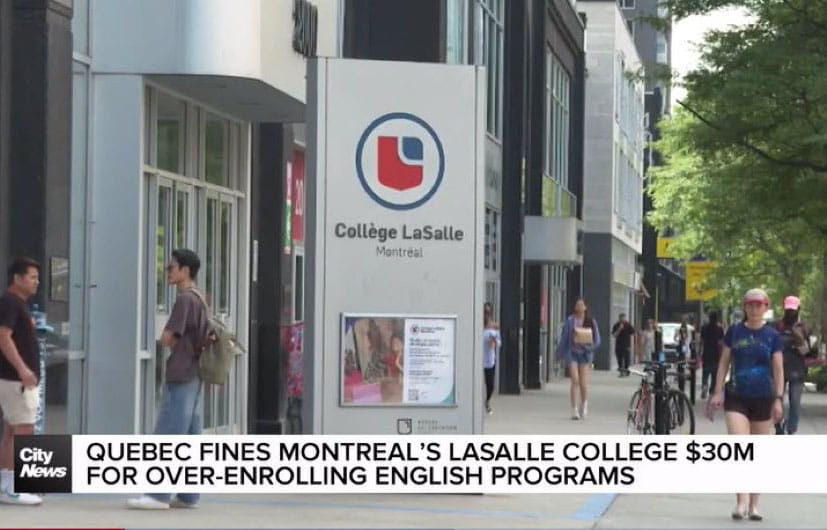
The Government of Québec has imposed a $30 million penalty on LaSalle College Montréal, for an administrative imbalance in the distribution of English-speaking students between our ACS and DCS programs.

However, all of these students were legally admitted with the required government authorizations.

The College had requested two years to adjust. That is exactly what it needed, since by the fall of 2025, the College was able to comply with the imposed caps. 

LaSalle College has always been a loyal partner of the Québec government, contributing to the education of thousands of young Quebecers. Today, this long-standing partner is facing a disproportionate and unfair penalty. 

In fact, the penalty is more than 1,000 times the fines imposed on companies found guilty of fraud, collusion, or actual environmental violations (e.g., in July 2025, Northvolt received a small $10,000 fine for failing to comply with metal limits in stormwater runoff). 

Rather than receiving support during a period of transition, the College finds itself abandoned by the very organization with which it has collaborated for more than 67 years. 

Summary of Facts

Since May 2021, LaSalle College has:

  • Actively participated in the democratic debate surrounding Bill 96 (which became Act 14).
  • Alerted the government as early as August 2021 that a rapid implementation of the caps would create significant difficulties, recommending a two-year transition period, given the length of its admissions cycle.
  • Received the new cap in February 2023, to be implemented starting in the fall of 2023. At that time, recruitment was well underway, and more than 700 Quebec Acceptance Certificates had already been issued to international students. 
  • The ministry has noted that the ACS programs have exceeded their quotas. However, the college remains below its DCS quota, and the overall number of English-language students has not increased since 2019. 
  • Received two separate penalties: $8,781,740 on June 28, 2024, and $21,113,864 on June 30, 2025; both are listed as liabilities on the balance sheet, significantly impacting financial performance. 
  • Has made numerous representations to the Minister of Higher Education, Ms. Pascale Déry, as well as to Premier Legault’s office and, since 2026, to Premier Fréchette.
  • Officially challenged the government’s decision in court to protect its rights before the deadline for filing a challenge expired in July 2024.
  • Received indirect support from Judge Éric Dufour, who, in a similar case (McGill and Concordia), denounced government decisions as “unreasonable” and not based on compelling evidence. 
  • Submitted several proposals to resolve the situation; all went unanswered. 


Despite these sustained efforts over more than five years—including several settlement offers that went unanswered—the College’s financial situation has worsened:

As of August 14, 2026, $3.6 million in grants due for July and August had still not been paid to the College, which is affecting its ability to begin the fall semester.

Why such a penalty?

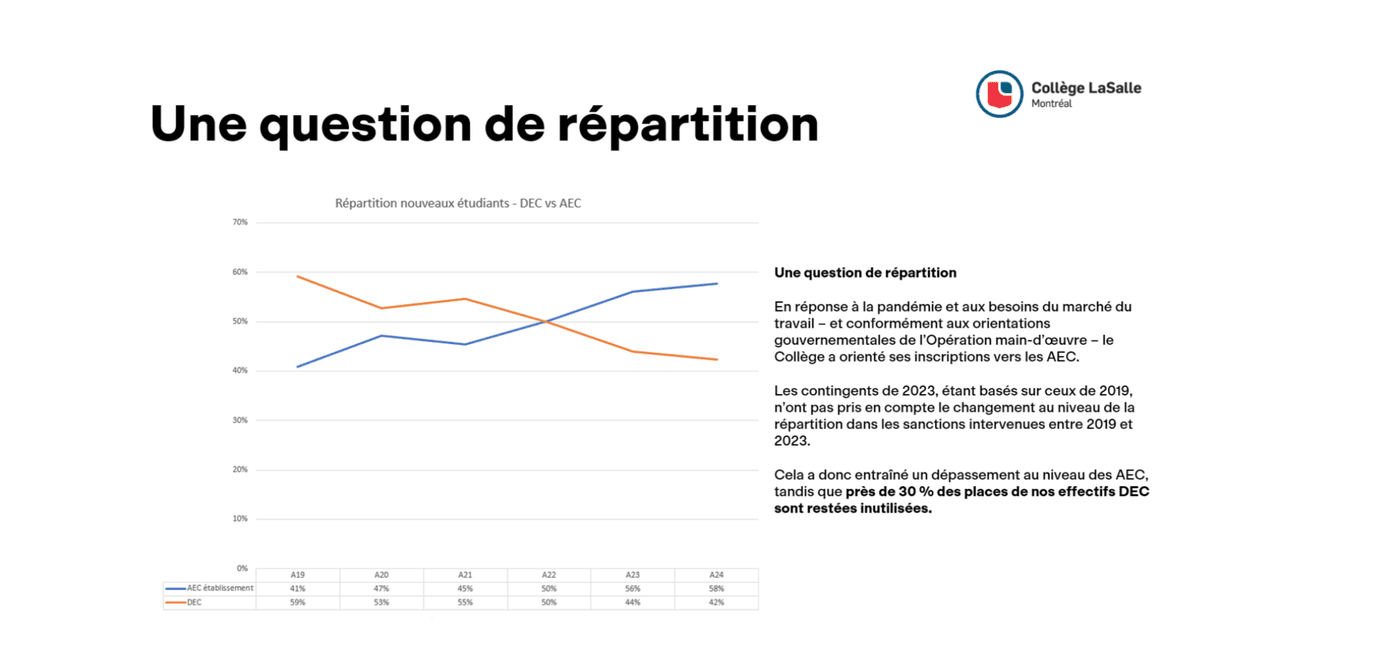
The total number of English-speaking students has not increased since 2019. This is not a matter of volume, but of the administrative breakdown between two types of diplomas (Attestation of College Studies (ACS) vs. Diploma of College Studies (DCS)).
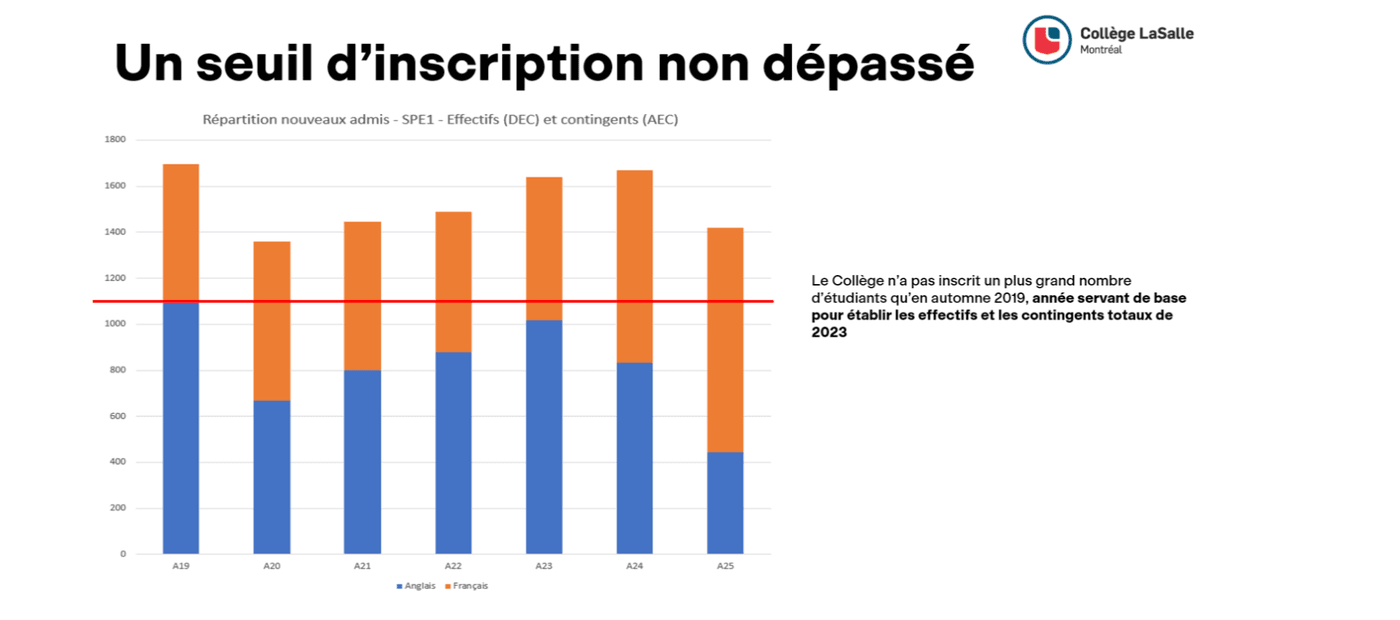
Picture-2025-1.pngPicture-2025-2.png


It is also important to note that following the pandemic, LaSalle College increased enrollment in certain ACS programs to meet professional retraining and workforce needs as part of the Québec government's “Operation Workforce” initiative launched in December 2021.

A Diploma of College Studies (DCS) is generally earned after two or three years of college study and can lead to university or directly prepare students for a trade. An Attestation of College Studies (ACS) is a shorter technical program, often intended for adults who wish to improve their skills, retrain, or enter the job market quickly.

Nevertheless, the government has imposed a disproportionate penalty, threatening an institution founded in 1959 with a 67-year track record of commitment to higher education, both here and in 10 other countries.

Our Perspective

We will always defend:

  • Our educational mission
  • Pedagogical innovation
  • French-language integration
  • Student success

FAQ